Perfidy by James Ellroy

September 5, 2014

Perfidia” by James Ellroy

Reviewed by Mark Lindquist
Special to the Seattle Times

James Ellroy can be ornery. “I hate hipsters, I hate liberals, I hate rock ’n’ rollers, I hate the counterculture, I hate movie people,” he said in an interview promoting his new novel, “Perfidia.” He also hates Presidents Clinton and Obama and has no use for the modern world.

Ellroy’s mother was murdered in Los Angeles when Ellroy was 10. The case was unsolved. “The Black Dahlia,” the first novel in Ellroy’s LA Quartet, was based on the unsolved murder of Elizabeth Short, which bore some similarities to the murder of Ellroy’s mother. Short’s body was found in an abandoned lot, mutilated, severed in half and posed. The press went crazy. Ellroy blended the facts of the case with fictional police officers and his own theories, which resulted in his 1987 breakout novel.

Three more novels completed Ellroy’s LA Quartet: “The Big Nowhere,” “LA Confidential” and “White Jazz.” Two of the books — “The Black Dahlia” and “LA Confidential” — were made into movies, and Ellroy became a literary celebrity of sorts. He followed the LA Quartet with The Underworld Trilogy: “American Tabloid,” “The Cold Six Thousand” and “Blood’s a Rover.” Writing about crime, corruption, greed, lust, brutality, drugs, madness and all the dark corners of the human psyche, Ellroy commingles fictional characters and incidents with historical characters and incidents, creating a weird pastiche of American life. 

His style, like his subject matter, is occasionally coarse.

“Perfidia” is a prequel to the LA Quartet and the Underworld Trilogy. Ellroy introduces us to younger versions of the characters who made him famous. Your appreciation of Ellroy’s unabashed attempt at the Great American Novel will depend, in part, on your familiarity with his oeuvre. I’ve read three of the seven books “Perfidia” riffs on and felt I was missing some pieces.

Still, the book is a compelling puzzle.

On the eve of the attack on Pearl Harbor, a Japanese-American family is found dead. Either they committed a ritualistic suicide, or they were murdered. Los Angeles Police Department Police Chief William H. Parker from “LA Confidential,” who was the actual police chief of the LAPD from 1950 until 1966, appears as Captain William H. Parker and oversees the investigation. Hideo Ashida, a police chemist, and the only Japanese-American employee of LAPD, is assigned to work the case.

Kay Lake, from “The Black Dahlia,” appears as a 21-year-old adventuress learning her way around LA. “I wanted to run away to Los Angeles and become someone else there … I was equal parts innocence and lunatic grit.” Kay’s chapters, written in first-person diary form, were among the most engaging for me, illuminating the motives and desires of the men who are intertwined by the investigation.

Beginning on Dec. 6, 1941, and unfolding in 23 days of real-time narration, “Perfidia” is a murder mystery, a subversive historical novel, and a dark meditation on power, politics, race and justice.

Perfidia, a Spanish word meaning treachery or betrayal, is the title of a song from the big-band era. Ellroy used the song in “The Black Dahlia,” and it obviously still speaks to him. With “Perfidia,” he repeatedly returns to the scene of the crime.

Pool by Ajay Sahgal

Sunday, February 13, 1994

“Pool” by Ajay Sahgal

Reviewed by Mark Lindquist
Los Angeles Times Book Review, Front Page

“Pool” is one of the most authentic Los Angeles novels you are likely to read and the beauty of it is that not a single moment is set in L.A.

Emery Roberts, a twentysomething movie star, has walked off the set of “Sun City,” a $40 million dollar buddy cop thriller, and gone to Vermont. The reader has no idea why. Emery, the narrator, also has no idea why.

“Pool” could have been subtitled “Portrait of an Unexamined Life” or “Why One Should Avoid Hanging Out with Young Actors.” Pointedly anti-plot and with ciphers for characters, “Pool” is nonetheless compelling thanks to Sahgal’s spare, cryptic prose.

“Pool” is “Waiting for Godot” for a generation whose gods are celluloid. This first novel is funny, sad, and filled with shocks of recognition, particularly for those who have ever felt lost in the modern Sodom known as Hollywood. “I can’t go on. I must go on. I can’t keep writing screenplays. I must keep writing screenplays.”

In Vermont Emery joins other Hollywood expatriates who are holed up at a farmhouse: a screenwriter, a fired CAA agent, and the “Sun City” producer’s alcoholic daughter and useless son. Along with Emery is Danny, a USC film school grad, the “next Phil Joanou,” who films Emery’s every move on videotape. Emery is oblivious to Danny and his omnipresent camera in much the same way that normal people in, say, Seattle, are oblivious to rain.

Necessarily lacking the physical details of L.A. – no Santa Ana winds, no sweet eucalyptic wetness in the air, no wild-eyed coyotes to run over in a Range Rover -“Pool” proves that L.A. is merely a transportable state of mind. L.A. is convincingly, disturbingly, brought to life in the Vermont countryside.

There’s all the vernacular, banter, celebrity fixation, and barely repressed anger endemic to Los Angeles. And it is not limited to the expatriates. When Emery visits the local bars, townie
girls fawn senselessly over him and their boyfriends want to kill him.

When the group needs money, they have a garage sale and there are plenty of local buyers for Emery’s used Yamamato blazer, and his unread copy of “Ulysses” – for the musical version with a score by Michael Bolton.

Only one character in the novel seems to have a goal of any kind: the screenwriter. He is building a pool in the backyard. And it is not just a goal, but an obsession. Though this is ostensibly motivated by the snapping turtles that roam the nearby lake in menacing packs, there is clearly more at stake.

Building the pool is the screenwriter’s raison d’etre. He envisions a cool, turtle-less place, a thing of beauty. What he creates, mostly, is a big hole filled with mud. And then the snapping turtles invade. This is one of the smartest, funniest metaphors for a screenwriter’s life that I have ever read.

“Pool” is chock full of wickedly funny bits that will be especially appreciated by industry insiders. Characters make deadpan references to movies with hilarious titles and plot lines that are all the funnier because the joke-movies are no more absurd than, say, “Encino Man,” “Problem Child,” “Stop, or My Mom Will Shoot,” or any number of other wildly profitable movies.

“Pool” has plenty of set pieces that scriptwriters are paid to fill pages with: a brawl, a roman candle fight, a car crash, and the big production number when an entire movie crew invades the farm house. What’s interesting is that these scenes read like parodies of what one would expect. The idiot-proof drama that makes these paint-by-number scenes popular with studio executives seems to be intentionally filtered out.

The characters in “Pool” are so disconnected from what is genuine that they feel nothing. There is not much to be felt in a cliché. There is not much to be felt when nothing is valued. This valuelessness that kills the possible joy of these characters lives even creeps into the sex scenes. They’ve arrived young to what self involvement and constant indulgence invariably lead to: emptiness, burn out.

Hollywood, in the end, wins. Emery becomes resigned to his fate, and his fate is to fly first class, have beautiful strange girls beg to sleep with him, and make millions of dollars, without ever understanding anything about any of it. If this does not sound especially hellish, it will after you read this scarily convincing portrait.

Emery’s most redeeming quality is that he is mercifully free of the self-involved self-help posturing that substitute in Los Angeles for living an examined life. Even that requires more self-examination than Emery can muster. He does, however, perform Public Service Announcements for “Rock Against Fur.”

Pete Hamill, after hanging around drunks and actresses for too many years, came to a realization. Hamill recognized, as he put it, that he had been performing rather than living his life. He stopped drinking. This saved him.

The characters in Sahgal’s novel are light years away from this kind of realization, and probably incapable of the kind of action that might save them. Sahgal wisely knows what about this is sad, funny, and, at moments, even moving.

“Pool” will not be a bestseller. It may, however, be destined for cult-classic status in Los Angeles.

Mark Lindquist is the author of two Hollywood novels, Sad Movies and Carnival Desires.

Blade Runner 2 by KW Jeter

Sunday, March 10, 1996

“Blade Runner 2” by KW Jeter

Reviewed by Mark Lindquist
Los Angeles Times Book Review

Seattle writer and lawyer Mark Lindquist has lived in and written about Los Angeles. He is the author of “Sad Movies” and “Carnival Desires.” 

Los Angeles, 2021. The atmosphere is scoured raw by the merciless Santa Ana winds. Fires flare as subterranean gases rise from the city streets and ignite. Relief comes in the occasional monsoons, which temporarily shield inhabitants from the blistering sun.

At night, multilingual neon glares senselessly from both vertical and horizontal buildings. Earthquakes are less of a concern now that the taller buildings lie in crooked angles on their sides, casualties of past seismic activity. The Van Nuys Pet Hospital still features the blinking pink puppy that is transformed from sad and injured to happy and bandaged every few seconds. You could use such a resurrection.

Whereas in the 1990s there was merely a small voice in your head telling you to leave town, now a United Nations blimp circles the city, exhorting you not only to leave town, but to leave the planet. “Start anew!” Unseen speakers boom out promises of a better life awaiting you among the stars you can only rarely glimpse. The brown stew of pollutants in the air is so thick the government-issue breathing masks seem beside the point. You’ve lost the will to deal with the scavenger dwarfs who steal the emission control units off vehicles stalled in traffic. On the plus side, nobody talks much about the O.J. Simpson trial anymore.

You tried to leave Los Angeles before. You moved north to the remote cabin where you stayed with the one you love, Rachel. Problem is, the one you love spends most of her time in a life-support pod. Also, she is not human. She is a replicant.

Replicants, designed by the Tyrell corporation for labor–slavery really–are almost indistinguishable from humans, but they have a life-span of four years. To extend your time together, you bring Rachel alive for a short spell every two months. Despite this, or maybe because of it, the relationship is going swell.

One other problem though. You are a blade runner. Blade runners are the must brutal of the formidably brutal Los Angeles Police Department. Blade runners have a simple job: exterminate escaped replicants.

Replicants, designed from human templates, are designed to lack emotion so they can excel as slaves. Some replicants seem to have developed emotions–or were they secretly designed that way?–and as a result they resent their servitude. They escape, and they become dangerous. Rachel was one of the five you were assigned to kill. You killed four. Then you quit. You quit not because you hated it, but because you realized you were liking it too much.

Now the powerful Tyrell Corporation wants you to resume your previous profession. There may be a sixth replicant on the run. Or there may not be. Circumstances are suspect, tinged with the haze of conspiracy. Some have even suggested you may be the replicant.

Still, your sense that you are human is reinforced by some tangible evidence: A human woman loves you. Sarah, the human template for Rachel, has inherited the Tyrell corporation from her father. Sarah wants to be loved. She wants to be loved by you. Sarah is willing to destroy the corporation for love. Anyone that irrational must be human.

So why love a replicant, rather than the human upon which she is based? Why love the copy? This is the biggest danger of living in Los Angeles: You have learned to prefer the dead to the living, the fake to the real.

Your original creator, Philip K. Dick, who authored “Do Androids Dream of Electric Sheep,” which was made into the movie “Blade Runner,” is dead. K. W. Jeter, however, has uncannily inhabited Dick’s mind and is continuing your story with a duplicate eye, voice, weltanschauung. Jeter’s sense of irony, his appreciation of the cosmic joke, parallels your increasingly dark tangled life. Jeter has craftily assimilated the mind of Dick with the minds of the “Blade Runner” screenwriters David Peoples and Hampton Fancher to the point where it’s hard to say for sure who created what.

All you know is that you must return to Los Angeles, take this last job, hunt for the sixth replicant. Complete this final assignment and you can be with the one you love. You can start anew. You can be human. You can even learn to prefer the real to the fake, though you are not sure how yet. First, you will have to be far from Los Angeles.

Sad Movies

Reviews

It’s a book that reads like a movie and demands to be read in one sitting; you get the same pleasure from reading this book that you can get from movies. It not only captures a certain Hollywood lifestyle, but it also sums up the period…. Sad Movies is both hilarious and affirmative, two traits which one rarely comes across in good books about Los Angeles — and which are both totally welcome here.

Bret Easton Ellis

Perceptive and hilarious…. One of the best sketches about a young man’s attempt to find himself since The Graduate.

New York Newsday

Among the most promising writers of his generation…. Lindquist’s sharp eye for detail defines not only his characters, but the entire atmosphere of 1980s Hollywood.

Los Angeles Reader

A strange, swiftly paced story that is funny and curiously powerful.

Denver Post

Clever … whimsical … a novel in dialogue about seeking the meaning of life.

Publishers Weekly

Lip-smackingly decadent … I can hardly wait for the movie.

New York Times Book Review

Not long ago, Gary Fisketjon left Vintage Books, where he had made a significant mark, to join Atlantic Monthly Press. He has taken with him at least one major author in Richard Ford, and the strong visual design that characterized his Vintage books. He has clearly not lost his ability to find good young American writing, if this new trade paperback is any indication…. Sad Movies begins like a hip, west coast version of Kingsley Amis’s Jake’s Thing, it soon turns into a sort of hip, west coast G.K. Chesterton’s Manalive…. Sad Movies is a rapid-fire, roller coaster sort of book…. Mark Lindquist has written an intriguing, likable novel, and Gary Fisketjon’s post-Vintage reputation appears safe.

Bookroom Review

Carnival Desires

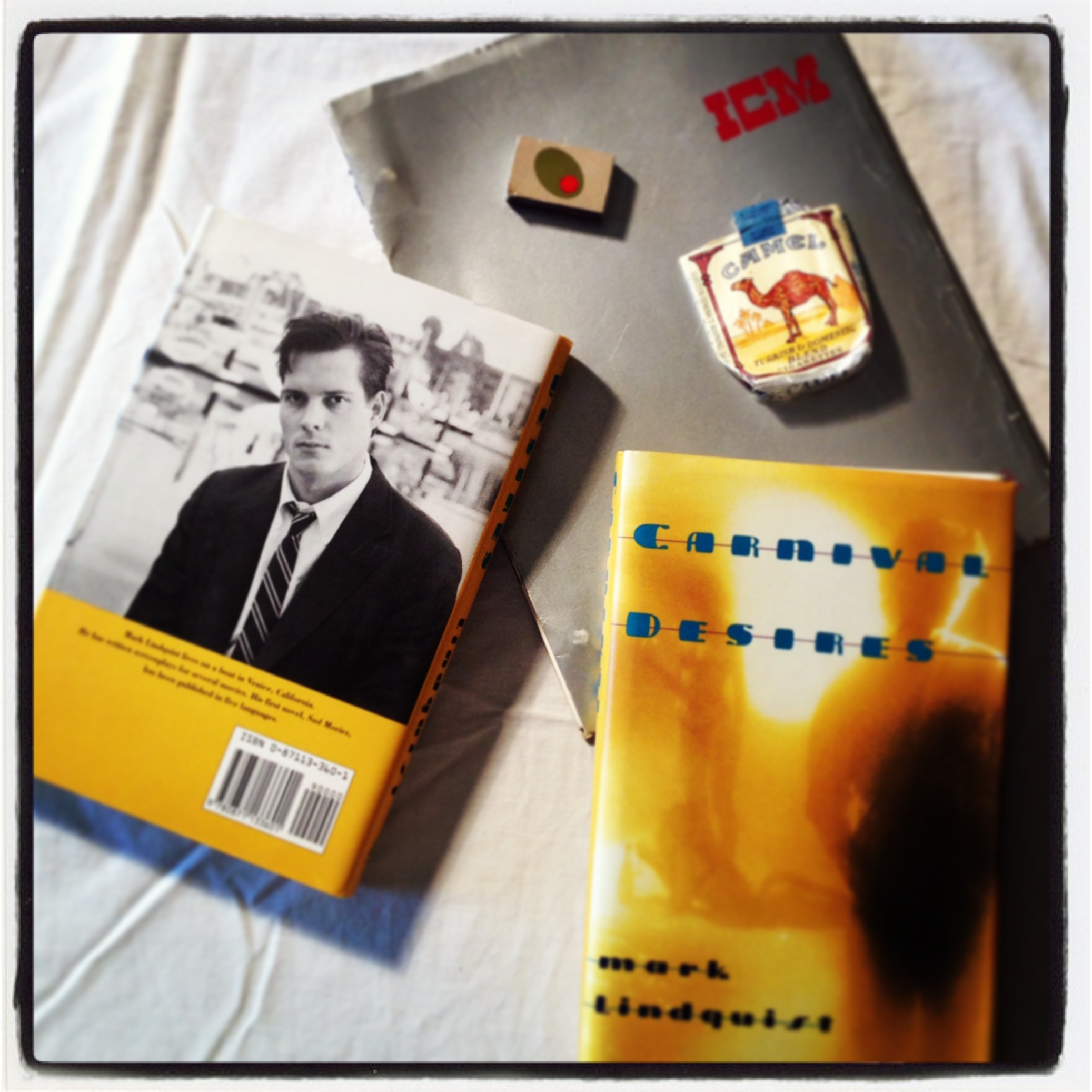
Published by Atlantic Monthly Press in 1990, Carnival Desires is now available on Kindle at Amazon. Carnival Desires follows a group of friends in their twenties through the trapdoors and funhouse mirrors of Hollywood in the 1980s….

What was once contemporary fiction is now a period piece. You can read about Carnival Desires in Vanity Fair or Details Magazine.

Reviews

Great postmodern literature. Romantic and cynical, true and original, full of modern ideas and seductive moments … as of its time as such classics as Day of the Locust and The Last Tycoon.

Details Magazine

A witty minimalist epic … with the smart, spare prose only an outsider on the Hollywood inside can afford.

Vanity Fair

Real characters in recognizable situations, written with wit and intelligence … the best contemporary novel about young Hollywood.

Los Angeles Reader

Carnival Desires is a story of today’s equivalent of the Bright Young Things. This is not a novel I would recommend to my mother or my aunts, but every priest, teaching sister, and director of religious education ought to be required to read it. Then they would understand why our religion must be taught exhaustively…. As for Mark Lindquist, he may well become the Evelyn Waugh of 21st Century America.

Catholic Twin Circle

Lindquist’s hip, lean dialogue and litany of debaucheries amuses, along with knowing flashes of behind-the-scenes Hollywood.

Publishers Weekly

Insightful … skillful … graceful.

Seattle Times

What could be more exciting than life in the fast lane of Hollywood? Just one long glitzy party in that familiar fantasy land of mansions and swimming pools, studios and trendy clubs. The only problem is, how do you get out of the fast lane when you find yourself slowing down?

This is starting to be the question for Bick Smith, going on 30, and his wealthy and/or talented friends Willie and Merri, Oscar and Mona, Tim and Joy. Willie and Merri will make it okay because they love each other, Oscar and Mona, probably, because they love their work. But for Tim and Joy, the only way out is a fatal crash. Bick gets off with only a smashed fender and a flat tire, presumably because his feelings are so ambivalent. One episode sums them up: Bick and his girlfriend, Jayne, go on the “Graveline Tour” — the sightseeing excursion past the places where famous Hollywood stars have died. As the trip proceeds, the guide’s repetition of “heavy alcoholism,” “rampant promiscuity” and “tragic death” becomes numbing: “Bick was both pained and perversely proud to be reminded that he was a part of something so ugly and so historically evil.”

Between his friend Libby, who doesn’t really belong to Hollywood, and Jayne, who is its very embodiment, the living projection of his own fiction, Bick wavers. Similarly, he wavers between the urge to run home to Seattle and lead a “normal more religious life” and the battered but still-breathing sense of vocation and of solidarity with friends in Los Angeles.

Like the milieu it describes, Mark Lindquist’s novel is glamorous, ribald, and clever if not always careful. What holds it together is a style of intense nervous suspense, reflected in the characters’ anxiety about endings. Oscar and Bick are both rewriting the ending of a film that in some ways is each man’s own story. Will Oscar’s teenage hero go for the bimbo cheerleader, or will he realize in time that it’s the other girl he really loves? Will Bick’s tormented husband and wife save each other or destroy each other?

Lindquist has a fine ear for dialogue and excels at varying scenes and voices, from witty repartee to drama to anguish, from the satiric to the erotic to the exuberantly scabrous. There is also a lot of movie talk that may be appreciated by those who keep up with the Hollywood scene.

Despite its suggestive title, there is no overt questioning of values in Carnival Desires. Values are traditional and mainstream. The novel even ends with a wedding. What is subverted is the role those values play. The characters seem to glimpse them in outer space from time to time, but almost never as guiding stars — much less stars to wish upon.

Anyway, are people who already have everything still capable of wishing? If they don’t constantly enjoy self-satisfaction, at least they do practice constant self-indulgence. And as Lindquist shows, even their self-destructive tendencies are perversely self-protective, a defense against pressure and paranoia, a substitute for religion and conscience.

The reduction of acts to images and the rejection of action as value-creating mark this novel’s post-modernism even more than its hip style and La Dolce Vita subject matter.

Carnival Desires may share the fate of many other works that paint too colorful a picture of the evils they purport to denounce. The public that finds books less satisfying than sex, alcohol, drugs, and MTV, is hardly likely to read — much less heed — the author’s warning to grow up before it’s too late. Despite his variation on the now-popular orgy-in-a-graveyard theme, we have a sneaking feeling that Lindquist still thinks some people can have it all.

Sally Pouvoir, Houston Chronicle

Books

Mark Lindquist is the author of four novels, The King of Methlehem, published by Simon & Schuster in 2007, Never Mind Nirvana, published by Random House/Villard in 2001, Carnival Desires, published by Atlantic Monthly Press in 1990, and Sad Movies, published by Atlantic Monthly Press in 1987.

His books have been bestsellers, are published in more than ten languages, and have been widely and well reviewed by major publications.

“Echoes and ties to both Hemingway and Fitzgerald.”– Boston Globe

“Lindquist … captures the zeitgeist.  He does what no one has done as well before.” – Buffalo News

“Dialogue that’s absolutely pitch-perfect.” – Washington Post

“Great postmodern literature.” – Details

“Deadpan and witty.” – LA Weekly

“Smart, spare prose.” – Vanity Fair

“All is handled with wit and style by Lindquist.” – Detroit News

“Lindquist … once again has a view of the zeitgeist.” – Los Angeles Times