What You Need in 2025

You can’t always get what you want, but if you try, sometimes you might find you get what you need.” 

When I saw The Rolling Stones in Seattle a few years ago, I thought it would be the last time. I was wrong. 

Sloane and I saw the Stones just outside San Francisco this year and it was the best time. 

Welcome to the Tenth Anniversary of the Lindquist New Year Newsletter, which covers music, movies, books, professional and personal highlights.

This is the unexpurgated version with more book recommendations, more music, more movies. For the original version with less words but more pictures, go here.

Thanks for reading every year, or some years, or maybe for the first year! 

We appreciate our friends more and more each passing year.

School

In our biggest news, Sloane, now 14, started Bellarmine Prep. So far, so good. She will be trying out for the tennis team in spring.

Meanwhile, Sloane’s musical taste continues to evolve with the help of excellent parenting. Besides The Rolling Stones, she enjoys The Beatles, The Bangles, Depeche Mode, the Cure, Metric, Taylor Swift, Nirvana, R.E.M., U2, and lately I’ve been playing Bob Dylan for her. Dylan is an acquired taste apparently. 

In the midst of her busy life, Sloane made her screen debut in Peter Farrelly’s new Mark Wahlberg movie, which was shooting in Australia on the Gold Coast. Sloane shares a scene with Mark. He was gracious and let her know the paparazzi were posting pics of them together. 

Sloane is a longtime fan of Peter. She loves comedies and especially loves Farrelly Brothers comedies. When we were staying with Peter in Ojai, she quizzed him about various actors, where he got his ideas, and what he was doing next. A year later, she was on set with him in Australia, seeing how movies were actually made.

Finally, Sloane is busy with Biscuit, her new blond dog, which has, of course, become our new blond dog. He looks and acts a little like Enzo in The Art of Racing in the Rain, but doesn’t talk as much. 

Chelsea continues to work as Director of Communications, Marketing, and Advancement for Bates Technical College. More people are choosing technical education over traditional four-year colleges these days.

Thanks

I’m happy to report Mark Lindquist Law was voted “Best Personal Injury Firm” in Pierce County, 2024. Thank you.

This public recognition validated my philosophy of only taking on select cases and select clients. Our boutique approach allows us to deliver the best service and best results.

There is no better feeling that knowing you did absolutely everything possible for a client. This year, I resolved a case against the City of Tacoma for $14.9 million. We also won several other large awards that were big victories for our clients. 

In April of 2025, my case against Boeing in the crash of the Max 8 in Ethiopia will finally go to trial in Chicago federal court. The Lion Air crash cases are all resolved. 

We also represent 34 passengers from the Alaska Airlines Max 9 door plug blowout at 16,000 feet. That case likewise is rolling forward toward accountability and justice. 

Meanwhile, I continue to do “expert legal commentary” for local and national media and I always appreciate hearing your feedback, thanks. 

Finally, contrary to rumor, I’m not moving ML Law to Hawaii where the cover photo from the original newsletter was shot. Everything I want and need is here, except when I travel for my band or ocean fix.

Seabrook

We’ve enjoyed Urban Ocean at Seabrook, our two-bedroom getaway. We are turning it into a rental though because we recently purchased a four-bedroom loft in Seabrook with extra tall windows looking out on the ocean. Our new place is called Aeroknot. We have an Instagram, but it’s not active yet.

What’s this mean for you? We have room for friends and family to visit! Give us a call or shoot us a text. We’re there whenever possible.

Also, before visiting, I must insist you watch The Truman Show, because that’s the feel of Seabrook. We look forward to you joining us.

As John F. Kennedy said, “We are tied to the ocean. And when we go back to the sea, whether to sail or to watch, we are going back from whence we came.” 

Books

No newsletter is complete without book recommendations. Ryan Holiday has a new book out: Right Thing, Right Now: Good Values. Good Character. Good Deeds. 

This is the third book in Ryan’s Stoic Virtues series. If I didn’t send you a copy for Christmas, and you want one, let me know. Books are the best gifts.

Walter Issacson wrote the smartest biography of Steve Jobs I read. So this year I picked up Issacson’s bio of Elon Musk, which is equally brilliant and especially timely. 

Earlier I mentioned The Bangles and now I have to add that the lead singer, Susanna Hoffs, wrote a novel any music fan and book reader will love, This Bird has Flown.

Returning to Peter Farrelly as well, his second novel, The Comedy Writer, is one of the funniest books ever written. Pete and I met when we were both writing our first novels. By coincidence, the same publisher, Atlantic Monthly Press, bought both of our manuscripts and Pete’s Outside Providence was published shortly after my first, Sad Movies.

Pete and I did readings together in L.A. in the eighties. I sort of remember this.

In between the time I wrote the original version of this new year newsletter and this unexpurgated version, David Lynch, the director, artist, Zen guy, and general visionary, died. He was 78, a smoker, and sui generis, if you’ll excuse my Latin. Catching the Big Fish, which he wrote, is possibly the best book I’ve read on the creative process.

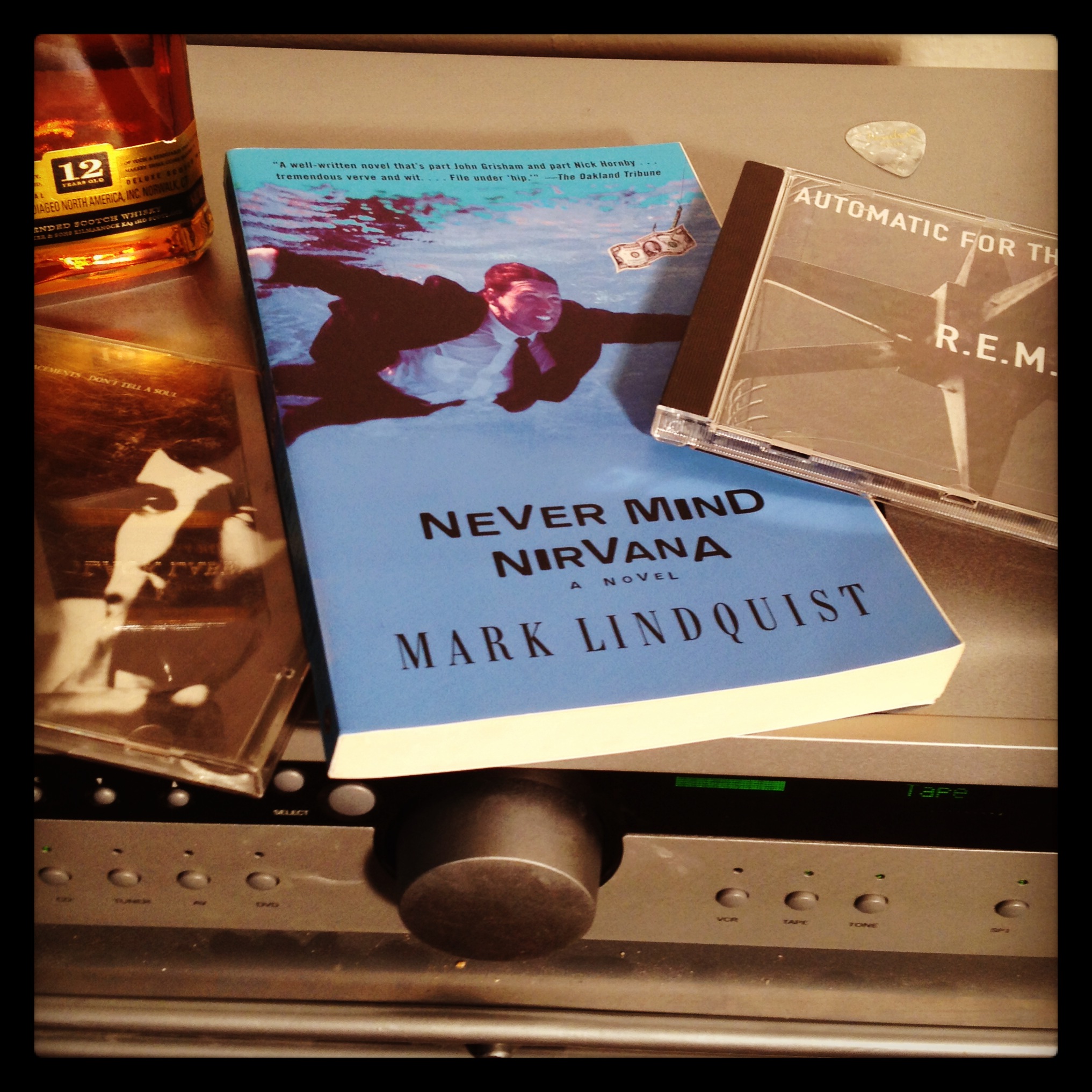
As for my own writing, the day job is slowing down my current projects, but I’m encouraged by notes and posts I still see about Never Mind Nirvana or The King of Methlehem, thanks. I always appreciate hearing from readers and fellow music fans.

We wish you all a happy, peaceful, and prosperous 2025 where you get what you need.

Thanks for reading.

Signed Books and Spirits Auction

Please join us November 17, 2016, at Kings Books in Tacoma, 7pm, for our 8th Annual Signed Books and Spirits Auction. #KeepOurProsecutor

Guest star auctioneers will be auctioning off signed books from Governor Jay Inslee, U.S. Representative Denny Heck, and, of course, me. New York Times bestselling authors Maria Semple and Garth Stein have also donated books as have Tacoma authors Jack Cameron and William Turbyfill. For more information, check our Facebook event page, our Facebook group page, or www.marklindquist.org.

I’m nearly done with my Zen Lawyer columns, which will be eventually collected into a book. Meanwhile, Chapter 8, a riff on opinions, facts, and the truth.

Norwegian Wood and Sputnik Sweetheart by Haruki Murakami

Arts & Entertainment: Sunday, June 3, 2001

Norweigan Wood and Sputnik Sweetheart by Haruki Murakami

Reviewed by Mark Lindquist
Special to The Seattle Times

“Norwegian Wood,” Haruki Murakami’s second novel, just published in America in paperback, sold more than 4 million copies in Japan when it was published in 1987.

Murakami became a literary star in his homeland. Tiring of his celebrity status, he moved to Italy, Greece and then the United States. After 10 years as an expatriate, he moved back to Japan.

The restless author’s writing has a flavor more American than most American writing. He has a keen feel for our pop culture – the music, the literature, the icons. His style is unquestionably unique, but there are obvious echoes of Raymond Carver and F. Scott Fitzgerald – both of whom he has translated into Japanese – and hard-boiled writers such as Raymond Chandler.

The title taken from the Beatles song, “Norwegian Wood” is a universal coming-of-age story: A 20-year-old college student named Watanabe loves two girls. One, Naoko, is a childhood friend living in a mental institution. The other, Midori, is a fellow university student whose vitality makes her the anti-Naoko.

Midori wears short skirts, talks frankly about sex and unabashedly believes in love.

Naoko, whose boyfriend committed suicide, warns Watanabe, “I’m a far more flawed human being than you realize. My sickness is a lot worse than you think: It has far deeper roots. And that’s why I want you to go on ahead of me if you can. Don’t wait for me. … Otherwise I might end up taking you with me.”

But Watanabe is 20 and in love and must follow the road to its end.

Some older Japanese critics consider Murakami frivolous because his characters seem disinterested in politics and social issues.

Young readers love him because he writes about detachment, individualism, romance and loneliness – and does so in clean, simple prose with occasional poetic bursts of surprising power.

His characters are partly defined by their preferences in music and literature, which is the universal prerogative of the young.

By largely ignoring the political battles of the 1960s, when the book is set, and instead focusing on the personal struggles of three individuals, Murakami wrote a book that is as relevant in America today as it was in Japan then.

“Sputnik Sweetheart” is Murakami’s seventh novel and his closest in tone and style to “Norwegian Wood.” The narrator, a 24-year-old teacher, is only slightly older than Watanabe and is similarly detached and existential.

“Who am I,” he asks. “What am I searching for? Where am I headed?”

The closest he comes to answering these questions, he feels, is in conversation with a 22-year-old woman named Sumire, an aspiring writer who quotes Jack Kerouac and wants to be like a character in one of his novels: “wild, cool, dissolute.”

The narrator tells her that without her his life would be like ” ‘The Greatest Hits of Bobby Darin’ minus ‘Mack the Knife.’ ”

Sumire, however, is in love with Miu, a businesswoman with bleached white hair who is 17 years older. Apparently abandoning her writing, Sumire takes a job as Miu’s personal assistant and travels to Greece with her. Sumire then disappears.

The narrator comes to Greece to help Miu look for her. What he finds instead of Sumire is two stories she has written on her laptop computer. One explains Sumire’s intense but ambivalent desire for Miu; the other, with shades of surrealism, explains Miu’s bleached hair and its cause, a bizarre incident that left Miu damaged and alienated.

This is a love story that becomes a metaphysical mystery and a meditation on human connection. “Sputnik Sweetheart” lacks the wide-eyed buzz of “Norwegian Wood,” but replaces this with an earned calm that is, in the end, even more satisfying.

My Life in Heavy Metal by Steve Almond

Entertainment & the Arts; Sunday, April 28, 2002

“My Life in Heavy Metal” by Steve Almond

Reviewed by Mark Lindquist
Special to The Seattle Times

This is the coolest and freshest collection of short stories I’ve read since the 1980s. While his contemporaries turn to novels and screenplays, Steve Almond has been publishing zeitgeist short fiction everywhere from Playboy to the literary journal Ploughshares.

All 12 of these stories deal with sex and regret. In the title story, David, a rock journalist in his 20s, tries to translate the adolescent ethos of rock and roll into his own love life and pays the adult price.

“Geek Player, Love Slayer,” an office romance between a female reporter and “Computer Boy,” is less successful, but still intriguingly of our time. “How did Computer Boy become the Lifeguard of our decade?” the narrator wants to know.

“Run Away My Pale Love” returns the reader to David. He’s older and courting a local in Poland. Different country, similar screw-ups: “There is a point you reach when you are just something bad that happened to someone else.”

“Moscow” is filler, a track you would skip if this were a CD. Almond’s writing is mostly first-rate, clear and perceptive, but he teaches creative writing at Boston College and his weaker stories seem designed for classroom consumption.

“How to Love a Republican” cranks things back up. Two political junkies pathetically destroy their attraction to each other against the backdrop of the Bush-Gore 2000 election.

The final story again features David, who is now a teacher in his 30s. David becomes involved with a 22-year-old woman and, unsurprisingly enough, screws up again. “But I am certain that you, too, have some episode in your life that lines up against this one, some mad period of transgression in which your body, your foolish body, led you toward tender ruin.”

Filmmaker Sandra Nettelbeck’s foreword to Never Mind Nirvana

Foreward to the German edition of “Never Mind Nirvana”

Mark Lindquist never makes anything up except names. He writes down his life. Not to know his other books and to start with “Never Mind Nirvana” is a little bit like opening a biography somewhere in the middle and starting to read there.

What I would like to say to you now is to put aside “Never Mind Nirvana” and read “Sad Movies” first, and then “Carnival Desires,” and only after that you should read “Never Mind Nirvana” and then you can look forward to his next novel that will come out soon because in that one you’ll find out how Pete Tyler, the hero of “Never Mind Nirvana,” is doing today. But unfortunately, “Sad Movies” and “Carnival Desires” are difficult to find (though “Sad Movies” may be published in Germany soon). And I certainly never lend my copies to anyone, not even to my closest friends (I had to buy “Sad Movies” about five times because nobody ever returned it). So when I was asked to write this foreword, I thought it would be a good idea to write down What Happened So Far. A kind of prologue for all those readers who didn’t have the pleasure like I did to have been there from the beginning.

Some sunny afternoon in the late Eighties, I pulled a paperback out of a shelf in my favorite bookstore in San Francisco because I liked the title. When I don’t know an author, I often only read the first sentence in order to decide whether I want to have the book or not. Mark’s first sentence in his first novel was:

I wonder why I don’t kill myself?

Sold.

I wonder why I’m wondering, then tell myself not to think like this and light a cigarette instead.

It’s about three A.M.

This is how “Sad Movies” begins, the story of a young guy living in Venice, California, who works for Big Gun Films and writes copy for softpornos about Las Vegas Showgirls with machine guns. The T Team – this is one job they can’t blow.” He decides his life would be more useful if put to an end, so his girlfriend will cash in on his life insurance, and then an old friend comes into town and talks him out of it. When he finally tells his girlfriend about his failed plan, she gets angry with him. He tries to calm her down. I was going to leave you a note absolving you.

Becky looks incredulous. What the fuck kind of note would have absolved me, she asks. You think you’re that good a writer?

In the end, they rescue a dog, and the hero survives, but then the story ends much too soon, you finish it much too quickly. And on the last page it says: Mark Lindquist lives in Venice, California. This is his first novel. I can’t remember how many times I reread “Sad Movies” back then, but I do remember why it put a spell on me. In all of its morbid melancholy it was so wickedly hopeful, dark in its humor, yet full of love for life, and deeply personal. Bret Easton Ellis hailed it as hilarious and affirmative – and I was dead sure Lindquist would publish another novel in no time.

But it took three years, and while I was anxiously waiting I kept hoping he wouldn’t change his mind and kill himself after all. In 1990 he finally published “Carnival Desires,” his second novel and my favorite one of his books, which I almost missed because there was only one hardcover edition. “Carnival Desires” kept every promise “Sad Movies” had made, and more. It was mature and beautiful and breathtakingly straight from the heart.

Classic rock, 97.1 KLSX. Now, new from U2 – Libby turns off the radio as she drives into the cemetary.

“Carnival Desires” begins with a funeral, a young man has taken his life. It is the story of a group of friends trying to survive in Hollywood. A desperate round dance on the edge of an emotional abyss, full of music, humor and tragedy, and the hero is a screenwriter named Bick who falls in love with an actress and he rewrites a script only for her and he still doesn’t get her in the end.

Of course we’re using each other, one of Bick’s friends tells him. But at least we like each other. Bick doesn’t want to die, but he does want another life, he wants to retire from screenwriting, turn his back on Hollywood, and he just doesn’t know how to do it. In the end, another friend is dead, and Bick, while trying to leave his driveway to leave town, has an accident and so he ends up staying and becomes Best Man at somebody else’s wedding.

And on the back of the book it said: Mark Lindquist lives on a boat in Venice, California. He has written screenplays for several movies.

At some point I heard that he had been dating Molly Ringwald, but that they had broken up. After that, nothing. For years I waited in vain for his third novel, and eventually I was convinced that he was burnt out, a drug addict – or dead. I left the States and for a few more years, I still looked for him in German bookstores, but finally I gave up.

Eleven years after its first publication, I read “Carnival Desires” again, I had almost forgotten how good it was, and I decided to search for Lindquist one last time. I was afraid to find an obituary somewhere in the internet. Instead I found his name on People Magazine’s Top 100 List of The Most Eligible Bachelors in the US, a very lively website – and finally an explanation for the years of silence. In the early Nineties, shortly after “Carnival Desires” got published, he had left L.A. to go back to his rainy hometown of Seattle, to go to law school and become a lawyer.

He began another life and what that one is like, you can find out in this book.

“Never Mind Nirvana” had only been published the year before I found out about it, and I read the book and wrote a torrid fan letter to the marklindquist.net website. Mark wrote me back. A year later I invited him to my premiere at the filmfestival in Seattle, and he was going to go to LA that weekend, but changed his mind because he was in the middle of a murder trial, so he showed up at the screening that night, and that’s how we met. Fifteen years after I had paid a couple of bucks for a paperback, shortly before the lights went down in the third row of a downtown multiplex theatre, Lindquist and I shook hands and said hello.

We’ve become friends since then, and that’s how I know that he never makes anything up. He recently said to me the truth is the best we can do. He’s right. And that’s exactly what he does in his writing.

He tells the truth about himself.

Mark’s life goes on and he is still writing it down. I deeply admire him for the courage to follow his calling. To find out more about that, you will have to wait for his next novel. But I’m sure I’m allowed to tell you this much: the new hero seems awfully familiar – and he lives on a boat.

And when I call him, Nirvana is still playing.

Sandra Nettelbeck, Berlin, 2002

Sandra Nettelbeck is the director of the German film “Mostly Martha,” which was adapted into the USA movie “No Reservations,” starring Aaron Eckhart and Catherine Zeta-Jones.