Whiskey Tango Foxtrot by David Shafer

August 3, 2014 

“Whiskey Tango Foxtrot” by David Shafer 

Reviewed by Mark Lindquist
Special to The Seattle Times

Literary fiction rarely seems edgy or even fun these days. One theory is that most of the smart, ambitious and talented writers started migrating to movies and television back in the 1980s.

Go west, young one.

David Shafer, author of “WTF,” missed the wagon train. We are lucky he did. His inventive, comic, dystopian semi-thriller restored my faith in fiction. Remember the TV show “Thirtysomething”? Shafer undoubtedly does. His novel is 30-somethings on pot, dosed with computers and conspiracy theories, zinging with wit and pop culture savvy.

His leading 30-somethings, Leo, Leila, and Mark, are brought together in an effort to oppose the Committee, a corporate cabal seeking to privatize and possess all the information in the world. Leo is a substance abuser with a trust fund, Leila is a former idealist working for an international nonprofit, and Mark is a best-selling and self-loathing self-help author.

Leila is recruited by the opposition, and she helps recruit Leo, who in turns helps with Mark. Leo and Mark are estranged friends from college. After Mark’s book, “Bringing the Inside Out,” became wildly successful, Mark ignored Leo. The book, “pretty basic stuff about how you’re never going to be certain, and there are too many variables to control for, and that probably the work of life is all about balancing,” deeply annoyed Leo.

James Straw, however, the master of the cabal, sees it as a motivational bible. He wants Mark to work for him as “Storyteller-in-Chief.” Straw offers Mark money and luxury. The equally shadowy opposition offers Mark, Leo and Leila “a chance to be part of something grander” than themselves.

Shafer’s writing is hip, wickedly hilarious, cutting edge, and ultimately concerned with old-fashioned notions of morality and redemption. He both mocks and adopts Mark’s counsel, “Build the world you want to be a part of.”

My Liar by Rachel Cline

May 30, 2008

“My Liar” by Rachel Cline

Reviewed by Mark Lindquist
Special to The Seattle Times

Hollywood novels have a natural allure. Rachel Cline, a screenwriter and author of a previous novel, “What to Keep,” uses the Tinseltown setting to good advantage in her new work, “My Liar.”

An unassertive and insecure film editor, Annabeth Jensen, becomes entangled in a friendship with a hip indie-film director, Laura Katz, and their ephemeral, tricky relationship is mirrored by the illusory nature of the movie business.

Unfortunately, the complexity of Hollywood, commerce and artistic endeavors proves to be more interesting than the maddening relationship between Annabeth and Laura.

Desperate for Laura’s approval, Annabeth displays one of the least attractive aspects of show business: the neediness. I kept thinking about Sally Field’s infamous trill after winning her second Oscar, “You like me, right now, you like me!”

Annabeth, who comes to Hollywood from Minnesota, escaping an alcoholic father and angry mother, is fully imagined and well drawn, but Laura, about whom we learn less, is more compelling. Explaining Annabeth to her husband, Laura says, “She’s not really someone I need to cultivate professionally, and she can be a bit … snarky, but sometimes there’s this, I don’t know, momentum when we talk, like when you have a crush on someone in high school. … It’s just weird.”

And yes, it is weird, and it gets weirder. Annabeth and Laura begin working together, on Laura’s low-budget movie about a wide-eyed girl from the Midwest who comes to Hollywood for fame and fortune like thousands before her, and in the process their relationship shifts from adolescent crush to something, well, more deeply neurotic. The movie, titled “Trouble Doll,” is yet another mirror in the funhouse of reflections Hollywood stories often become.

Cline is a gifted writer with a clean, economical style, and she well understands both the psychology and the topography of Los Angeles and the movie business. Though I suspect Annabeth may embody some of Cline’s experiences as an artist in Hollywood, Laura seems to be the character with whom the author is more engaged.

Making a movie, like most serious efforts at art, requires an almost monomaniacal, and sometimes ruthless, devotion. The most interesting relationship in this book, for me, was the one between Laura and her movie.

Happy New Year 2019

Happy new year!  “And now let us believe in a long year that is given to us, new, untouched, full of things that have never been, full of work that has never been done.”

Here is my 2018 year-end list of books and movies. These are not necessarily the best. These are not necessarily even from 2018. Instead, these are just books and movies I got around to recently and recommend.

Christopher Robin, a wonderful movie about the creative process and the Zen of Winnie the Pooh. “Sometimes doing nothing leads to the very best something.”

Ego is the Enemy, by Ryan Holiday, a smart book about doing your best work. “Impressing people is utterly different from being truly impressive.”

Mastery, by Robert Greene, a mentor to Holiday. “You must value learning above everything else.”

Reading is not the only way to learn, but it is one way.

Thanks for reading.

August Activities

The events are endless, from street fairs to community celebrations, but for Sloane it is always about face painting. Chelsea and I appreciate all of you who greet us, share stories, and encourage us to keep up the good fight. We are grateful for the volunteers who continue to step up. Let us know if you want to join us, thank you. www.marklindquist.org

I do not have much time for reading these days, but I did finish The Obstacle is the Way: The Timeless Art of Turning Trials into Triumph by Ryan Holiday and it’s still on my nightstand next to Meditations by Marcus Aurelius. Ryan was kind enough to send me his other books, too. I’ll report on those later. “Wherever we are, whatever we’re doing and wherever we are going, we owe it to ourselves, to our art, to the world to do it well.”

Love is a Racket by John Ridley

October 11, 1998

“Love is a Racket” by John Ridley

Reviewed by Mark Lindquist
New York Times Book Review

John Ridley’s crime-noir first novel, ”Stray Dogs,” was made into the Oliver Stone movie ”U-Turn.” This may explain why Ridley’s second novel, “Love is a Racket” (Knopf, $24), blends elements of the noir novel with the Hollywood novel.

True to the first genre, the book’s hero, a hard-drinking con man named Jeffty Kittridge, owes money to Dumas, a bad guy with a deceptively soft voice who just might kill him. True to the second, Jeffty is also a hard-drinking, burned-out screenwriter already being slowly killed by ”the gulag L.A.” Enter Mona, a street urchin with a striking resemblance to the actress Pier Angeli — who, Jeffty reminds us, killed herself with an overdose of pills. The first thing Mona says to Jeffty is ”Change?” She’s begging for money, but the double meaning is soon clear. Jeffty recruits her for a scam that could turn his life around.

The plotting is routine, but the writing is smart and edgy and even moving; if Richard Ford wrote genre fiction, it might read something like this. The only weaknesses result from unfortunate conformities to the noir formula and a digressive first act. Once Mona appears, however, Ridley has us hooked on his game.

Model Behavior by Jay McInerney

Arts & Entertainment: Sunday, December 6, 1998

“Model Behavior” by Jay McInerney

Reviewed by Mark Lindquist
Special to The Seattle Times

In the late ’70s and early ’80s we called it “punk” when an artist said never mind the critics or, for that matter, the general public. “Bright Lights, Big City,” Jay McInerney’s first novel, was punk.

The odds would have been against its publication if not for McInerney’s friendship with editor Gary Fisketjon, who happened to dream up a line of paperback originals called “Vintage Contemporaries.”

After spending the latter half of the 15 years since “Bright Lights” straining for literary respectability, McInerney has slipped back on his red shoes for “Model Behavior,” his fifth novel. He has gleefully and shamelessly rewritten “Bright Lights” for the 1990s. Restaurants replace clubs as social focal points, celebrities replace cocaine as the metaphorical evil, and surrender replaces redemption as the semi-sunny ending, but the one-line synopsis is the same: beautiful model dumps young writer and sends him into a tailspin that forces him to search for a moral compass.

The lead character in “Model Behavior,” Conner McKnight, is a celebrity journalist burdened with just the right mix of self-satisfaction and self-loathing. The plot, such as it is, revolves around McKnight’s pursuit of an interview with a young actor.

McInerney uses the first person when he wants to write casually, switches into the second or third person when he wants to remind the reader he can write astoundingly well, and maintains a sneering energy throughout.

This is the literary equivalent of three-chord rock and roll, and I liked it. Voice, McInerney’s strong suit, drives the book more than the occassionally absurd story line. He writes of “toxic body consciousness,” and “carping the diem,” and “too little rapture of late.” He pulls chapter titles from R.E.M. lyrics, references obscure pop songs from the 1980s, and mistakenly refers to Sean MacPherson’s defunct Los Angeles restaurant The Olive as “a club in West Hollywood” just to see if anyone is paying attention. He has fun.

F. Scott Fitzgerald, who by law must be mentioned in any review of McInerney, felt that writers have one or two truly powerful experiences in their lives and that we spend our careers telling the story of the resulting emotion over and over. One of McInerney’s most powerful experiences to date has been, apparently, being dumped by a model. Proof of his skill and artistry is found in the fact that from this personal trifle he has written some of the most relevant literature of our time.

The seven accompanying stories, in contrast, are technically astute and, well, kind of boring. They could be interpreted as gropes for approval after the critical beatings McInerney’s work took in the 1980s. Interestingly, the New York Times Book Review, quite stingy in its recent appraisal of “Model Behavior,” still lauds these stories as “models of the form.” Yes, and there is little that distinquishes them from other models of the form. With the exception of “Smoke,” a fascinating outtake from McInerney’s fourth novel, “Brightness Falls,” these stories mostly serve to prove that McInerney can write like his elders, albeit with flair. I was put in mind of Nirvana covering a Perry Como song.

E.M. Forster said that fiction can do what history books cannot: capture the “buzz of implication” of an era. I predict that 40 or 50 years from now, when most of the critics’ current favorites are forgotten, McInerney will be enjoying a posthumous comeback and “Model Behavior” will be a popular computer disk, particularly among college students.

McInerney will be read in the future for his humanistic understanding and rendering of the buzz of our era. So why wait? Read him now.

Not Ready Prime Time by Brent Askari

Entertainment News: Sunday, August 15, 1999

“Not Ready for Prime Time” by Brent Askari

Reviewed by Mark Lindquist
Special to The Seattle Times

In his book “On Becoming a Novelist,” John Gardner, the writer and teacher who was a mentor to Raymond Carver among many others, had this advice for writers:

“One of the most common mistakes among young writers is the idea that a story gets its power from withheld information – that is, from the writer’s setting the reader up and then bushwhacking him.”

Bushwhacking is an unfortunate technique of playwright Brent Askari in his first novel. He ends chapters with sentences like, “And when I did find out the truth, it blew my mind.” This is especially unfortunate because his story does not need cheap tricks.

Justine Nichols, the narrator, a 22-year-old lead singer for an all-girl band, is a charming and engaging character. Abandoned by her parents and raised by an alcoholic aunt, she’s an intriguing study in dysfunction. Askari’s writing continually rings true in this territory.

Justine’s bandmates are drawn equally well: “Tara didn’t fit in with any of the high school crowds. Even the angst-ridden life-sucks-so-let’s-dress-in-black-and-worship-death crowd didn’t like her, because they thought she was a downer.”

I would have liked to spend more time with the band, but the story moves, as it must, to Justine’s confrontation with her mother, a TVstar Justine has never seen in the flesh. Their face-to-face comes in the hospital where the mother is staying after a suicide attempt. This scene, like most of the emotional high points, is handled with grace and wit.

Through the course of the story, Justine has two boyfriends who are her dysfunctional equals, but she is clearly not ready for love. By the end, having confronted her past and herself, she may be.

Love Hexagon by William Sutcliffe

Arts & Entertainment: Sunday, October 1, 2000

“Love Hexagon” by William Sutcliffe

Reviewed by Mark Lindquist
Special to The Seattle Times

A United Kingdom best seller, this satirical sex farce has a clear target audience: twentysomething Londoners. Comparisons to Evelyn Waugh are inevitable, at least the Waugh of the “Bright Young Things” stage, but for contemporary American readers, the more apt comparison may be the sitcom “Friends.”

Sutcliffe’s writing is smarter and wittier than “Friends,” the situations are more real and involving, and of course Sutcliffe has that dry Brit style going for him. On the other hand, Sutcliffe’s characters are even more neurotic and annoying than the dim-witted cast of “Friends.”

Lisa and Guy are “the old married couple,” though they are not married; Josh, Lisa’s co-worker, is the pathetic one; Keri, the tart who carelessly crushes men’s hearts, is the good-looking one, Graham, Guy’s sidekick and drinking buddy, is the comic one; and Helen, Guy’s friend, is the equally familiar angst-ridden one.

Reduced to types, these characters sound like clichés of their age group, but Sutcliffe injects them with life. His dialogue is first rate, his insights brutally incisive and his mercy nearly nonexistent.

One of the potential shortcomings of satire is a lack of forgiveness for human foibles, and Sutcliffe can be especially unsparing. I began wondering if he really loathes his contemporaries. The leniency Sutcliffe showed his self-involved hero in “Are you experienced,” his first novel, is missing here, at least until the end.

While the other characters are left in uncertain lurches, Guy and Helen meet up in the Greek Islands for a minor epiphany. This scene – like much of the book – is screenplay-like in its visual appeal and unstated implications. We’re swept out of the literal and metaphorical claustrophobia of urban life into a larger world of possibilities, and Sutcliffe shows that he doesn’t really despise his peers, or at least not all of them.

Norwegian Wood and Sputnik Sweetheart by Haruki Murakami

Arts & Entertainment: Sunday, June 3, 2001

Norweigan Wood and Sputnik Sweetheart by Haruki Murakami

Reviewed by Mark Lindquist
Special to The Seattle Times

“Norwegian Wood,” Haruki Murakami’s second novel, just published in America in paperback, sold more than 4 million copies in Japan when it was published in 1987.

Murakami became a literary star in his homeland. Tiring of his celebrity status, he moved to Italy, Greece and then the United States. After 10 years as an expatriate, he moved back to Japan.

The restless author’s writing has a flavor more American than most American writing. He has a keen feel for our pop culture – the music, the literature, the icons. His style is unquestionably unique, but there are obvious echoes of Raymond Carver and F. Scott Fitzgerald – both of whom he has translated into Japanese – and hard-boiled writers such as Raymond Chandler.

The title taken from the Beatles song, “Norwegian Wood” is a universal coming-of-age story: A 20-year-old college student named Watanabe loves two girls. One, Naoko, is a childhood friend living in a mental institution. The other, Midori, is a fellow university student whose vitality makes her the anti-Naoko.

Midori wears short skirts, talks frankly about sex and unabashedly believes in love.

Naoko, whose boyfriend committed suicide, warns Watanabe, “I’m a far more flawed human being than you realize. My sickness is a lot worse than you think: It has far deeper roots. And that’s why I want you to go on ahead of me if you can. Don’t wait for me. … Otherwise I might end up taking you with me.”

But Watanabe is 20 and in love and must follow the road to its end.

Some older Japanese critics consider Murakami frivolous because his characters seem disinterested in politics and social issues.

Young readers love him because he writes about detachment, individualism, romance and loneliness – and does so in clean, simple prose with occasional poetic bursts of surprising power.

His characters are partly defined by their preferences in music and literature, which is the universal prerogative of the young.

By largely ignoring the political battles of the 1960s, when the book is set, and instead focusing on the personal struggles of three individuals, Murakami wrote a book that is as relevant in America today as it was in Japan then.

“Sputnik Sweetheart” is Murakami’s seventh novel and his closest in tone and style to “Norwegian Wood.” The narrator, a 24-year-old teacher, is only slightly older than Watanabe and is similarly detached and existential.

“Who am I,” he asks. “What am I searching for? Where am I headed?”

The closest he comes to answering these questions, he feels, is in conversation with a 22-year-old woman named Sumire, an aspiring writer who quotes Jack Kerouac and wants to be like a character in one of his novels: “wild, cool, dissolute.”

The narrator tells her that without her his life would be like ” ‘The Greatest Hits of Bobby Darin’ minus ‘Mack the Knife.’ ”

Sumire, however, is in love with Miu, a businesswoman with bleached white hair who is 17 years older. Apparently abandoning her writing, Sumire takes a job as Miu’s personal assistant and travels to Greece with her. Sumire then disappears.

The narrator comes to Greece to help Miu look for her. What he finds instead of Sumire is two stories she has written on her laptop computer. One explains Sumire’s intense but ambivalent desire for Miu; the other, with shades of surrealism, explains Miu’s bleached hair and its cause, a bizarre incident that left Miu damaged and alienated.

This is a love story that becomes a metaphysical mystery and a meditation on human connection. “Sputnik Sweetheart” lacks the wide-eyed buzz of “Norwegian Wood,” but replaces this with an earned calm that is, in the end, even more satisfying.

JPod by Douglas Coupland

Entertainment & the Arts: Friday, June 09, 2006

“JPod” by Douglas Coupland

By Mark Lindquist
Special to The Seattle Times

“I think people in the year 2020 are going to be nostalgic for the sensation of cluelessness.”

“I’ve come to the conclusion that documents are thirty-four percent more boring when presented in the Courier font.”

“If you’re an incredibly famous rich person who does more in one day than I do in a month, does your perception of time’s passing go slower or faster than it does for me?”

Douglas Coupland’s latest book, “JPod,” is billed as a novel, and it does resemble a novel in some ways — words, characters, dramatic incidents — but it is more precise to say this is a collection of random thoughts and observations, ironic dialogue, word games and number puzzles.

Coupland has returned to the geeky techie culture he explored in his 1995 success “Microserfs,” but with even less of a story line and less emotional engagement. Given the book’s form, it seems pointless to relate the plot. Suffice it to say that the narrator Ethan Jarlewski and five co-workers at a Vancouver, B.C., video-game-design company are subverting the game they are charged with creating.

Ethan describes his colleagues in “Living Cartoon Profiles.” None of the characters are fully fleshed out, and this appears to be intentional. As one of them says, “You feel chilled because you have no character. You’re a depressing assemblage of pop-culture influences and cancelled emotions, driven by the sputtering engine of only the most banal form of capitalism. You spend your life feeling as if you’re perpetually obsolete — whether it’s labour market obsolescence or cultural unhipness.”

Except in instances such as these when Coupland speechifies through his characters, or when he is portraying someone over 30, his dialogue is pitch-perfect. He knows his main subjects. In his 40s and well-established, Coupland still best understands twentysomethings drifting in oceans of information. However, he remains detached from their issues and, as a result, so does the reader.

There are many moments of brilliance in these pages, such as Coupland’s analysis of “micro-autism” in both the general population and the computer industry. There are also some missteps, such as when he takes a tip from the postmodern how-to book and casts Douglas Coupland in a major supporting role.

” ‘Oh, God,’ ” the book begins, warning us, ” ‘I feel like a refugee from a Douglas Coupland novel.’ ”

Though fans of “Microserfs” and “Generation X” should enjoy Coupland’s latest musings and mischief, he will not win many converts with this one.

Books

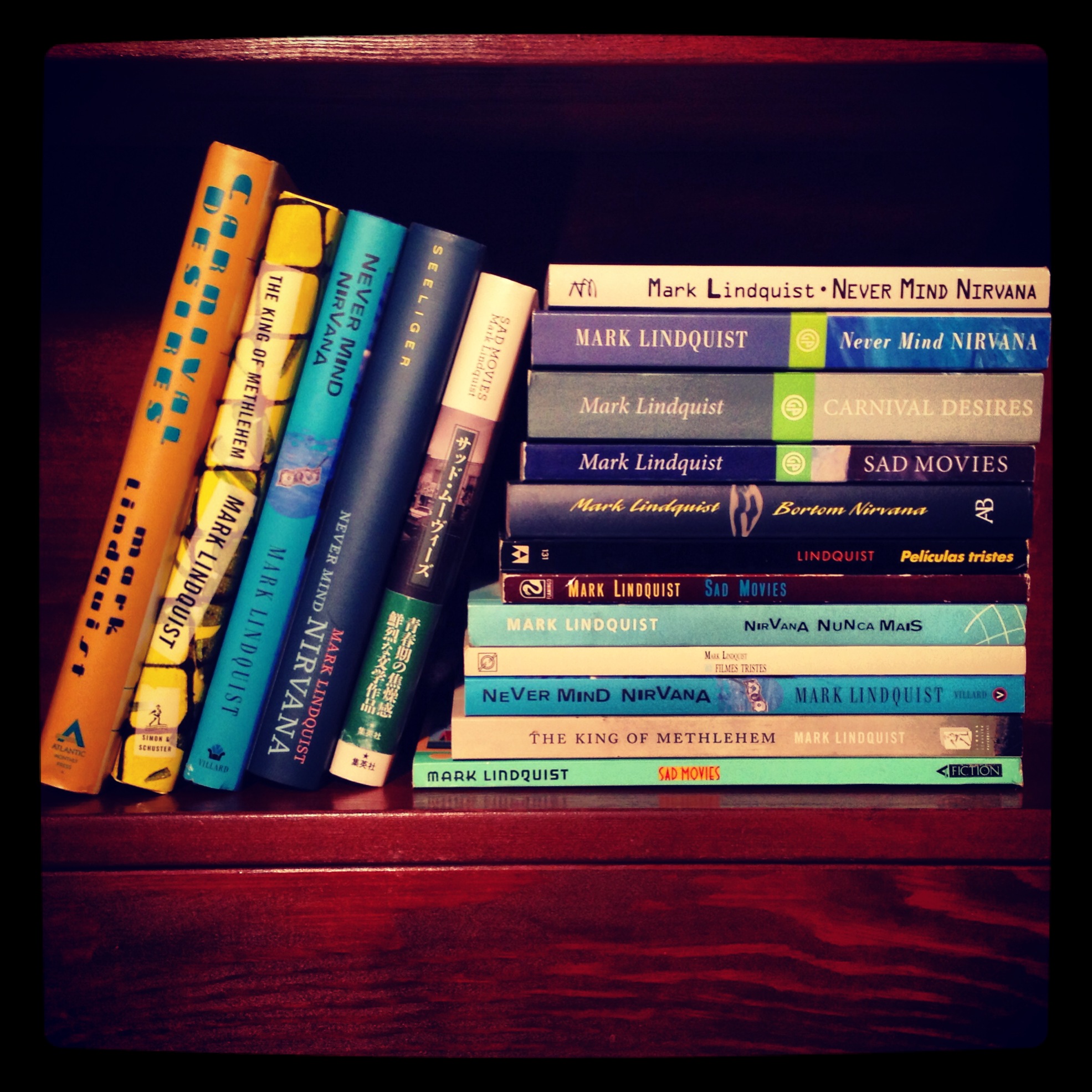
Mark Lindquist is the author of four novels, The King of Methlehem, published by Simon & Schuster in 2007, Never Mind Nirvana, published by Random House/Villard in 2001, Carnival Desires, published by Atlantic Monthly Press in 1990, and Sad Movies, published by Atlantic Monthly Press in 1987.

His books have been bestsellers, are published in more than ten languages, and have been widely and well reviewed by major publications.

“Echoes and ties to both Hemingway and Fitzgerald.”– Boston Globe

“Lindquist … captures the zeitgeist.  He does what no one has done as well before.” – Buffalo News

“Dialogue that’s absolutely pitch-perfect.” – Washington Post

“Great postmodern literature.” – Details

“Deadpan and witty.” – LA Weekly

“Smart, spare prose.” – Vanity Fair

“All is handled with wit and style by Lindquist.” – Detroit News

“Lindquist … once again has a view of the zeitgeist.” – Los Angeles Times